







iSwitch 2000U-TR Demo Video
Check hardware intorduction of the iSwitch 2000U-TR...


Large AV projects require flexible signal distribution, efficient system management, and long-term scalability. Traditional HDMI matrix systems remain suitable for fixed installations, but larger commercial AV environments often require solutions that can support multiple sources, displays, and locations.
AV over IP provides a network-based approach for professional AV distribution, enabling flexible deployment, centralized control, and easier system expansion.
At INFOBIT „iVoice H300 (neu)“ — INFOBIT AV, we provide professional AV solutions for commercial applications. Our iSwitch 265TR AV over IP transceiver combines encoder and decoder functions in one device, supporting enterprise AV integration, control rooms, video walls, and distributed AV systems.
A traditional HDMI matrix is a hardware-based switching system that connects multiple HDMI input sources with multiple HDMI output displays. It allows users to select different signal sources and distribute them to specific displays through direct HDMI connections.
For fixed AV installations where all devices are located in the same area, HDMI matrix systems can provide stable signal switching.
|
Eigenschaften |
Traditional HDMI Matrix |
|
Signal transmission |
Direct HDMI connection |
|
System expansion |
Requires larger matrix hardware |
|
Cabling method |
Dedicated HDMI cables |
|
Multi-location deployment |
Limited flexibility |
|
Large-scale management |
More complex |
The main challenge of traditional HDMI matrix systems is scalability. As the number of sources and displays increases, the system requires more physical connections and larger switching hardware.
Common challenges include:
For large AV environments, flexible routing, centralized management, and future expansion become important factors during system design.
An AV over IP system uses network infrastructure to transmit audio and video signals instead of relying on direct HDMI connections between every source and display.
The typical workflow is:
HDMI Source → Encoder → Network Switch → Decoder → Display Device
The encoder converts HDMI signals into network streams, while the decoder receives the network signal and outputs HDMI video to display devices.
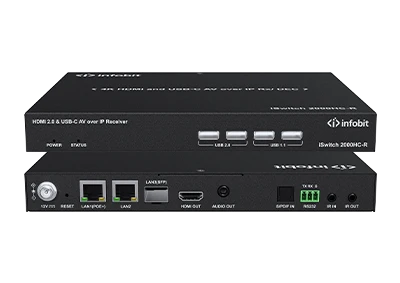
Die iSwitch 265TR supports this architecture by integrating encoder and decoder functions into one transceiver. In encoder mode, it supports one HDMI 2.0 input and HDMI loop output. In decoder mode, it provides HDMI output for display devices, allowing integrators to design more flexible AV systems.
AV over IP technology uses video compression to improve transmission efficiency. H.264/H.265 encoding and decoding help reduce bandwidth requirements while maintaining high-quality image performance.
Die iSwitch 265TR supports H.264/H.265 video processing, 4K@60Hz 4:4:4 video transmission, HDMI 2.0b compliance, and 18Gbps video bandwidth.
These features support professional applications including:
|
Comparison |
HDMI-Matrix |
AV over IP Solution |
|
Architektur |
Hardware switching |
Network-based distribution |
|
Expansion |
Limited by matrix size |
Expand by adding endpoints |
|
Cabling |
Dedicated HDMI cables |
Standard network cables |
|
Multi-room deployment |
More complex |
Flexible deployment |
|
Signal routing |
Fixed switching structure |
Flexible network management |
|
Video wall support |
Requires additional processing |
Designed for distributed systems |
Scalability is one of the main reasons organizations choose AV over IP solutions for large projects.
A traditional HDMI matrix requires users to define input and output capacity before installation. If system requirements increase, upgrading hardware may become necessary.
An AV over IP system provides a different approach. Additional encoder and decoder devices can be added while using existing network infrastructure, allowing the system to expand according to project requirements.
Die iSwitch 265TR supports signal distribution, switching, extension, and matrix functions through a Gigabit network switch. It supports 1000M Base-T network transmission and PoE power supply, helping integrators build flexible AV systems.
This architecture is suitable for:
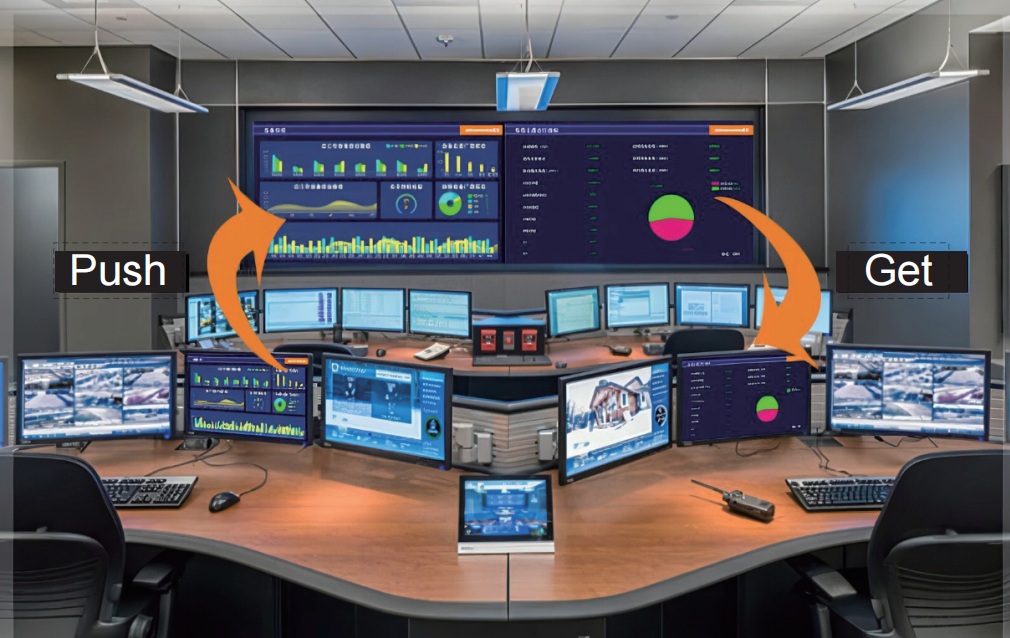
Video walls are widely used in control rooms, monitoring centers, and commercial display environments. AV over IP provides a flexible method for managing multiple display endpoints within a network.
Die iSwitch 265TR supports video wall functions, including horizontal and vertical splicing, multi-screen display management, and high-resolution image processing. It can synchronize video signals across different display terminals, including LCD splicing screens and small-pitch LED displays.
For multi-source monitoring applications, the device supports free window display output. One decoder unit can process up to 16 signals with functions including windowing, roaming, overlaying, and splicing, allowing operators to view multiple sources on a single display.
Large control environments often require centralized computer operation. The iSwitch 265TR supports KVM collaborative management, allowing operators to control multiple PCs through a keyboard and mouse.
This function enables one person to manage multiple computers while supporting centralized computer deployment in a computer room.
Typical applications include:
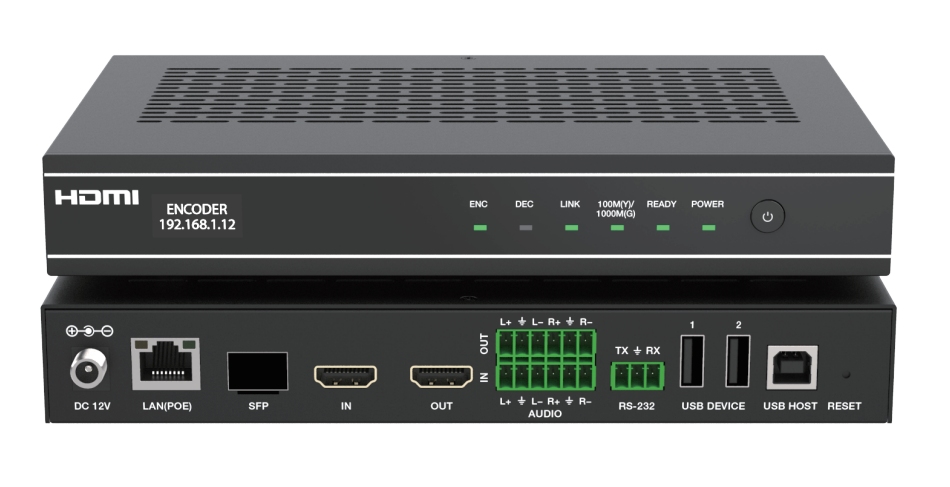
Die iSwitch 265TR combines encoder and decoder functions in a single device, providing flexible deployment options for system designers and integrators.
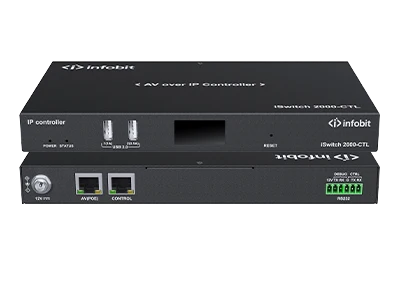
It supports multiple control methods, including RS-232, TCP/IP, APP control, and Control Server integration. Customized scene modes help simplify system configuration for different applications.
With support for 4K60 AV transmission, H.264/H.265 processing, video wall functions, KVM collaboration, and network-based distribution, iSwitch 265TR provides a flexible foundation for modern distributed AV system design.
For project requirements, system design consultation, or customized AV solutions, contact INFOBIT „iVoice H300 (neu)“ — INFOBIT AV to discuss your application needs.
An HDMI matrix uses direct hardware connections between HDMI sources and displays, while an AV over IP system uses network infrastructure to distribute audio and video signals. AV over IP provides greater flexibility for large installations requiring expansion, multi-room deployment, and centralized management.
Yes. AV over IP solutions are suitable for applications requiring flexible signal distribution, multiple display endpoints, and centralized control, including enterprise AV integration projects and large commercial environments.
Yes. AV over IP systems can support scalable video wall deployments. The iSwitch 265TR supports video wall functions, including horizontal and vertical splicing, multi-screen management, and high-resolution video processing.
Yes. The iSwitch 265TR supports KVM collaborative management, allowing operators to control multiple PCs using keyboard and mouse while supporting centralized computer deployment.
A 4K AV over IP encoder decoder is suitable for applications requiring high-quality video distribution, including control rooms, video walls, enterprise presentation systems, monitoring environments, and distributed AV systems.
Bitte hinterlassen Sie Ihre Anforderungsdaten unten, damit wir Sie sofort kontaktieren können.
