







A Dante converter can look simple, but selecting the wrong signal direction stops the audio path before commissioning begins. The key question is whether analog XLR audio must enter the Dante network or Dante audio must leave the network through XLR. At INFOBIT AV, we provide dedicated transmitters, receivers, and bidirectional wall plates for these different requirements. This guide explains how to identify the correct format before requesting a quotation.
XLR to Dante and Dante to XLR Are Opposite Signal Paths
An XLR to Dante tool does the exact reverse of a Dante to XLR unit. Both devices link analog sound gear to the Dante network. Yet, the analog-to-digital change happens at different spots in the audio chain.
With an XLR to Dante device, analog sound travels into the unit through XLR ports. Then, the device changes it into Dante digital audio.
A Dante-to-XLR receiver works in the reverse direction. It receives Dante digital audio through RJ45 and converts that signal into analog audio available through XLR outputs.
The most reliable selection method is therefore to identify the audio source and destination. Connector count matters, but it should be checked only after the required signal direction is clear.
When Do You Need an XLR-to-Dante Converter?
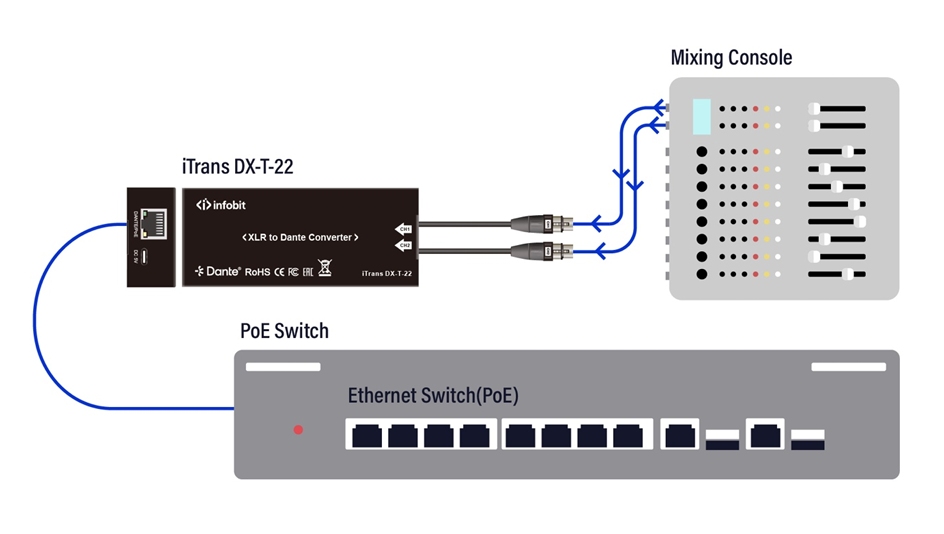
An XLR-to-Dante converter is required when analog audio must enter the Dante network. The analog source connects to the converter’s XLR inputs, and the converter sends the resulting digital audio to the network.
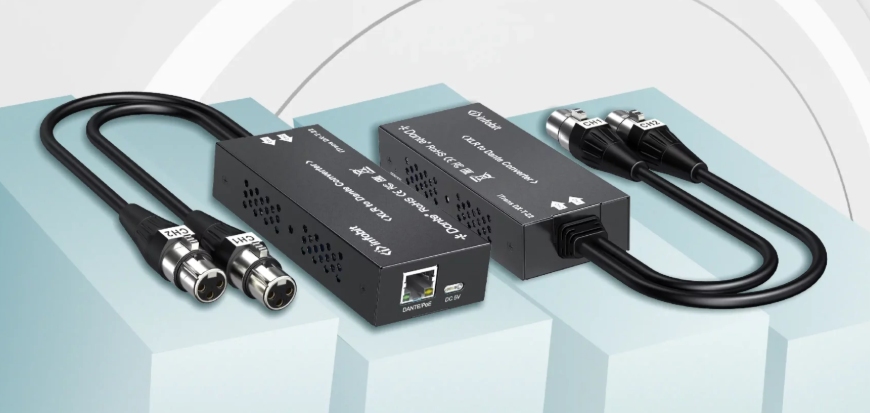
The iTrans DX-T-22 is a two-channel XLR-to-Dante analog transmitter. It provides two analog input channels and two Dante output channels. Its analog side uses two XLR-F connectors, while the Dante output uses one RJ45 connector.
This configuration makes the direction easy to identify:
Analog XLR source → DX-T-22 transmitter → Dante network
The transmitter has a frequency response of 20 Hz to 20 kHz within ±0.5 dB and supports PoE. Power and Dante audio can therefore use the network connection when the installation has a compatible PoE supply.
The channel count should still be confirmed before selection. The DX-T-22 carries two analog input channels into two Dante output channels. It should not be specified as an analog output device simply because the product has XLR connectors.
When Do You Need a Dante-to-XLR Converter?
A Dante-to-XLR converter is required when audio from the Dante network must reach analog equipment. Dante audio enters through the network connector, and the receiver provides analog XLR outputs.
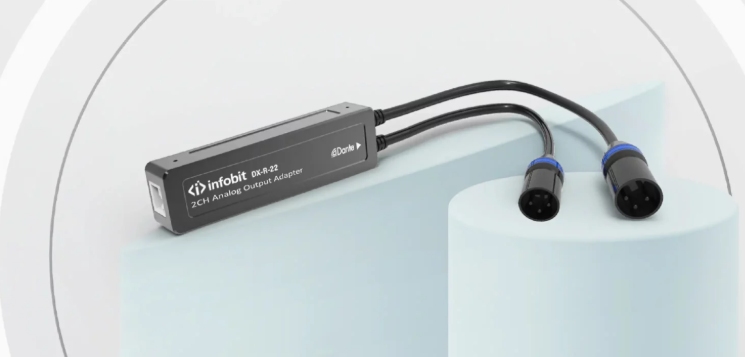
The iTrans DX-R-22 is a two-channel Dante-to-XLR analog receiver. It has one RJ45 Dante input and two XLR-M analog outputs. Its channel configuration consists of two Dante input channels and two analog output channels.
The working direction is:
Dante network → DX-R-22 receiver → analog XLR equipment
The receiver has a frequency response of 20 Hz to 20 kHz within ±0.5 dB. It supports PoE and Dante software. The unit can extend audio, control, Ethernet, and power over Cat cable.
The receiver cannot replace the transmitter at the source side. If an analog device needs to place audio onto Dante, the project requires analog inputs rather than analog outputs. Defining “input to the network” and “output from the network” in the system drawing prevents this common specification error.
Dante to XLR vs XLR to Dante Comparison
The following table shows the main differences between the two converter directions.
|
Selection point |
XLR to Dante |
Dante to XLR |
|
Converter model |
ИТранс DX-T-22 |
ИТранс DX-R-22 |
|
Device type |
Analog transmitter |
Analog receiver |
|
Signal direction |
Analog audio to Dante digital audio |
Dante digital audio to analog audio |
|
Channel configuration |
2 analog inputs and 2 Dante outputs |
2 Dante inputs and 2 analog outputs |
|
Analog connectors |
2 × XLR-F inputs |
2 × XLR-M outputs |
|
Dante connector |
1 × RJ45 output |
1 × RJ45 input |
|
Частотный ответ |
20 Hz–20 kHz, ±0.5 dB |
20 Hz–20 kHz, ±0.5 dB |
|
PoE support |
Да |
Да |
The comparison shows why “Dante converter” alone is not a complete purchasing description. A quotation request should state the conversion direction, analog connector type, channel count, network interface, and power requirement.
When Is a Bidirectional XLR Dante Wall Plate More Suitable?
A bidirectional wall plate is more suitable when a fixed connection point must send analog audio to Dante and receive Dante audio at the same location.
The iTrans DX-22-US and DX-22-EUK provide two Dante inputs and outputs together with two XLR inputs and outputs. Unlike a dedicated transmitter or receiver, each wall plate supports conversion in both directions.
The wall plates accept balanced or unbalanced XLR analog audio. They also support 48 V microphone phantom power, controlled through a physical button. Input sensitivity and output gain can be adjusted for different microphone and XLR signal levels.
Both versions support Данте аудио sampling rates of 44.1, 48, 88.2, and 96 kHz at 24 bit. Dante device latency can be configured at 1, 2, or 5 ms through Dante Controller. AES67 RTP audio transport is also supported.
The difference between the two versions is the installation format. The DX-22-US uses a standard 2-gang US faceplate. The DX-22-EUK uses an EU and UK all-in-one design with a standard 2-gang EU/UK faceplate. Both have magnetic covers and can use PoE or local power.
Check the Complete Audio Path Before Ordering
Signal direction should be documented from the source to the destination. A system diagram should show whether each analog device supplies audio, receives audio, or needs both functions.
Channel count should be checked at the same time. The dedicated DX-T-22 and DX-R-22 each handle two channels in one direction. The wall plates provide a 2×2 bidirectional configuration.
Connector gender should not be treated as a small mechanical detail. The DX-T-22 uses two XLR-F inputs, while the DX-R-22 uses two XLR-M outputs. The connected cables and equipment must match these interfaces.
Power availability also affects installation planning. All four converter options support PoE, while the US and EU/UK wall plates additionally support local power. Confirming the planned power method avoids adding an unsuitable unit to a location without the required supply.
Match the Technical Settings to the Project
Sampling rate and bit depth should be confirmed when a bidirectional wall plate is specified. The DX-22-US and DX-22-EUK support 44.1, 48, 88.2, and 96 kHz at 24 bit.
Latency should be selected as part of Dante system configuration. The wall plates provide 1, 2, or 5 ms settings through Dante Controller. The selected value should follow the project’s Dante configuration rather than being left undefined in the equipment schedule.
AES67 requirements should also be stated before ordering. The two wall-plate versions support AES67 RTP audio transport. This specification is relevant when AES67 support is included in the system design.
Microphone requirements need separate confirmation. The dedicated transmitter provides two analog XLR inputs, while the wall plates specifically include switchable 48 V phantom power and adjustable input sensitivity. If phantom power is required at the connection point, this should appear clearly in the purchasing brief.
Select the Correct Dante XLR Converter
A proper Dante converter request starts with a simple sentence. State if you need analog XLR into Dante, Dante out to XLR, or both ways at a single wall plate. After that, you can check the channel count and connector gender. You should also review PoE, faceplate style, sampling rate, latency, AES67, and phantom power. This keeps things clear. To verify a model or get a project quote, contact INFOBIT AV through our Dante Audio page. Send us your signal flow, gear list, or project file. We will give it a full technical review.
Часто задаваемые вопросы
Do I need both an XLR-to-Dante transmitter and a Dante-to-XLR receiver?
You need both when the system must carry analog audio into the Dante network at one location and deliver it as analog audio at another. A one-way application may require only a transmitter or only a receiver. A bidirectional wall plate can handle both directions at the same installed position.
Can the converters be powered through the network cable?
Yes. The DX-T-22 and DX-R-22 support PoE. The DX-22-US and DX-22-EUK wall plates support both PoE and local power. The available power method should be confirmed when preparing the system design.
Which option supports 48 V phantom power for microphones?
The DX-22-US and DX-22-EUK wall plates support 48 V microphone phantom power with on/off control through a physical button. They also provide input sensitivity and output gain adjustment for different microphone and XLR levels.
What information is needed for an accurate quotation?
A quotation request should include the signal direction, number of channels, XLR connector requirement, wall-plate or standalone format, PoE availability, installation region, sampling rate, latency setting, AES67 requirement, and whether 48 V phantom power is needed.
Which wall plate should be used for US, EU, or UK installations?
The DX-22-US uses a standard 2-gang US faceplate. The DX-22-EUK uses an EU and UK all-in-one design with a standard 2-gang EU/UK faceplate. Both provide 2×2 Dante and XLR input/output capability.
