







iSwitch 2000HC-R Demo Video
Check hardware intorduction of the iSwitch 2000HC-R...


Dante audio carries digital audio between compatible devices through an Ethernet network. For system integrators and AV buyers, it provides a structured way to connect analog, XLR, USB-C, Bluetooth, and HDMI ARC sources with processors and output devices. At インフォビット AV, we develop Dante interfaces, wallplates, audio bridges, DSPs, and controllers for professional installations. This guide explains their roles using specifications from our product knowledge base.
Dante audio is a form of audio over IP used to transmit digital audio between network-connected devices. In a typical system, an interface converts the source signal into Dante audio, the network carries that signal, and another compatible device receives or processes it.
The source does not have to be digital. Dante interfaces can accept balanced or unbalanced analog audio, microphone-level signals, XLR audio, Bluetooth audio, USB audio, or HDMI ARC audio. This allows existing audio equipment to become part of a networked system without requiring every source to use the same connector.
Dante systems can also support bidirectional communication. A transceiver may send audio from a computer to the network while returning another audio signal from the network to the same computer. This function is useful when a system requires both playback and recording.
Selected Dante devices support AES67 RTP audio transport. AES67 support allows compatible products to work within an AES67-based audio environment, provided that the system configuration and device specifications match.
A Dante signal path starts with an audio source. The source connects to an encoder, transmitter, transceiver, wallplate, audio bridge, or DSP through the required physical interface.
The Dante device converts the incoming signal into network audio and sends it through an RJ45 connection. Compatible Cat cabling carries audio, control, Ethernet data, and, on supported devices, power. A network switch connects the Dante endpoints.
Dante Controller can then configure supported devices and direct audio to the required destination. Depending on the installation, that destination may be a decoder, XLR receiver, analog output interface, DSP, USB transceiver, or another Dante-compatible device.
The receiving device converts or processes the signal according to its function. An analog decoder, for example, converts Dante audio into balanced or unbalanced analog output. A Dante DSP can mix, equalize, control, and route several input and output channels.
|
System stage |
Main function |
Relevant device type |
|
Audio source |
Produces analog or digital audio |
Microphone, computer, display, smartphone or tablet |
|
Dante input |
Converts the source into Dante audio |
Encoder, XLR wallplate, USB transceiver, Bluetooth adapter or HDMI ARC converter |
|
Network connection |
Carries audio and control signals |
RJ45 connection, Cat cable and network switch |
|
Audio routing |
Directs audio between compatible endpoints |
ダンテ コントローラー |
|
Signal processing |
Applies mixing and audio processing |
Dante-enabled DSP |
|
オーディオ出力 |
Converts or delivers the routed signal |
Analog decoder, XLR receiver, USB interface or another Dante endpoint |
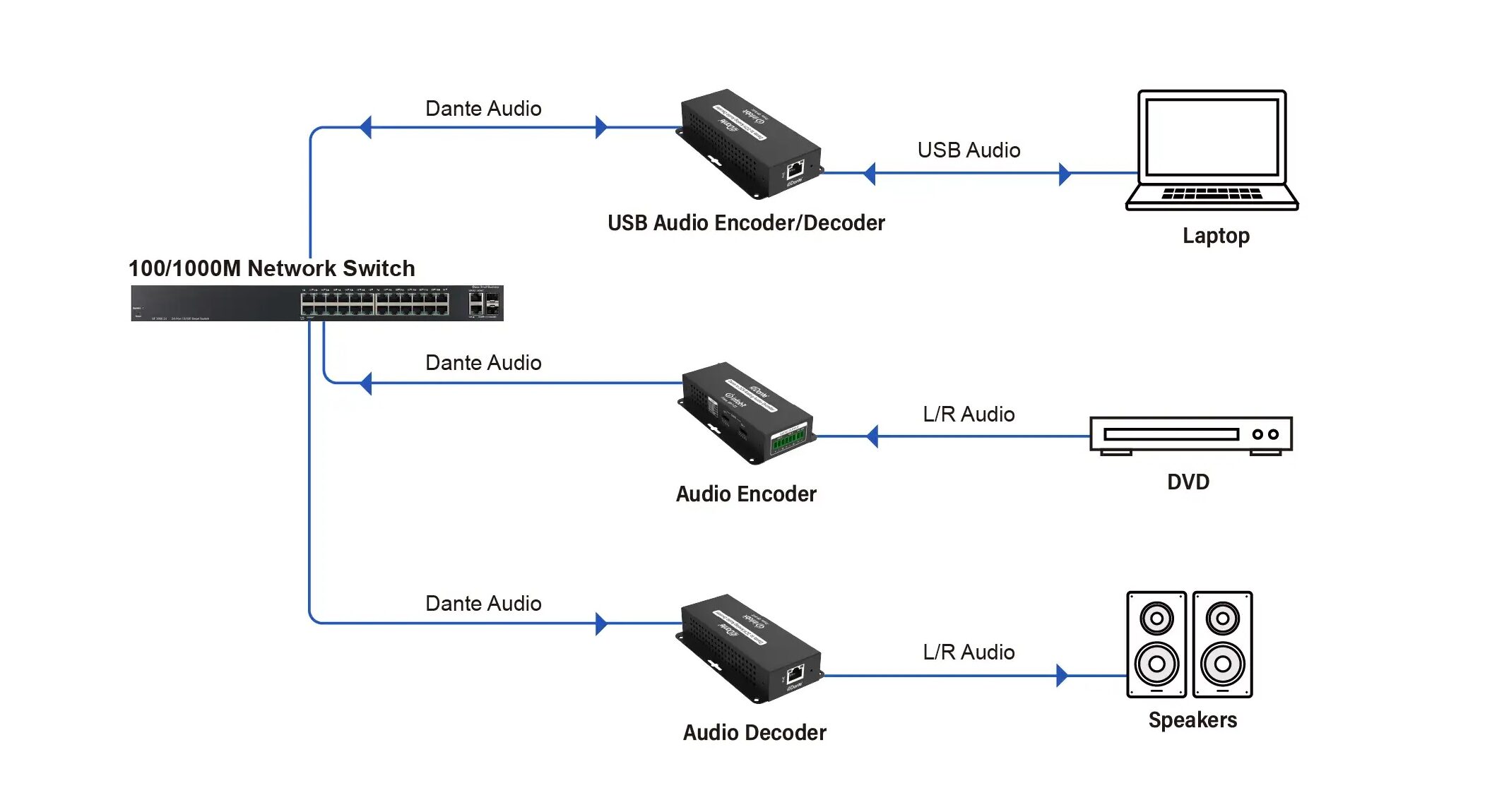
Analog-to-Dante conversion is required when a system includes traditional line-level or microphone-level equipment. Phoenix interfaces provide a compact option for connecting balanced or unbalanced audio.
「 The iTrans DP-T-22 is a two-channel Dante Phoenix transmitter. It converts two analog inputs into two Dante output channels. Supported sampling rates are 44.1, 48, 88.2, and 96 kHz at 16-, 24-, or 32-bit depth. Five input sensitivity settings are available: +24 dBu, +4 dBu, 0 dBu, 0 dBV, and -10 dBV. The unit supports AES67 RTP transmission and can receive power through 12V DC or IEEE 802.3af PoE.
「 The iTrans DP-R-22 performs the reverse process. It receives two Dante channels and provides two balanced or unbalanced analog outputs. Its sampling rates, bit depths, sensitivity settings, AES67 support, and power options match those of the transmitter.
For bidirectional operation, the iTrans DP-BOX-202 includes two analog inputs, two analog outputs, and two-channel Dante input and output. Input gain can be adjusted from 0 to +48 dB, while output volume ranges from -60 dB to 0 dB. Each input supports 48V phantom power. The device operates at 44.1 or 48 kHz and is controllable through Dante Controller and a web user interface.
XLR-to-Dante interfaces connect professional microphones and analog audio equipment to the network. They also provide a direct Dante-to-XLR path when analog output is required.
「 The iTrans DX-T-22 is a two-channel XLR-to-Dante transmitter with two XLR female inputs and one RJ45 Dante output. The iTrans DX-R-22 is a two-channel Dante-to-XLR receiver with one RJ45 input and two XLR male outputs. Both models have a frequency response of 20 Hz to 20 kHz, within ±0.5 dB, and support PoE.
Wallplate models provide installed XLR connectivity. The iTrans DX-22-US and DX-22-EUK each offer two XLR inputs and two XLR outputs, with Dante input and output. They accept balanced or unbalanced XLR analog audio and support selectable 48V microphone phantom power.
Both wallplates support 44.1, 48, 88.2, and 96 kHz Dante audio at 24-bit depth. Device latency can be set to 1, 2, or 5 milliseconds through Dante Controller. They also support AES67 RTP transport, input sensitivity adjustment, output gain control, PoE, and local power. The US model uses a standard two-gang US faceplate, while the EU/UK model uses a combined EU and UK format.
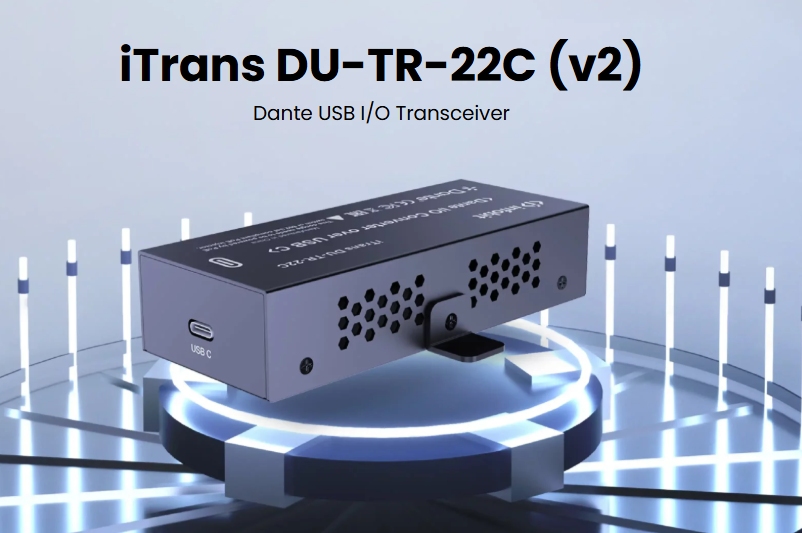
A. Dante USB interface provides a direct connection between a computer and the audio network. It can carry audio in both directions, which supports playback and return-audio workflows.
「 The iTrans DU-TR-22C v2 is a USB-C Dante I/O transceiver with two input and two output audio channels. It supports 24-bit audio, plug-and-play operation, and IEEE 802.3af PoE. Type-C-to-Type-C and Type-C-to-Type-A cables are included, allowing connection to different host ports.
「 The iTrans DU-TR-22B uses USB-B and complies with USB Audio Device Class Specification V1.0 and USB 2.0 Full-Speed operation. It supports AES67 RTP audio transmission and sampling rates from 44.1 to 96 kHz at 16-, 24-, or 32-bit depth. Power can be supplied through USB 5V or PoE.
Bluetooth-to-Dante products allow smartphones and tablets to serve as audio sources. The iTrans DB22 converts two-channel Bluetooth audio into two-channel Dante audio. It supports Bluetooth 5.1 and SBC, AAC, aptX, aptX Low Latency, and aptX HD formats. Dante audio operates at 48 kHz and 24-bit, with configurable delays of 1, 2, or 5 milliseconds. Power is available through USB-C or IEEE 802.3af PoE.
Installed Bluetooth wallplates are available as the iTrans DB44-US and DB44-EUK. These 4×3-channel Dante wall panels support one-key Bluetooth pairing, Bluetooth 5.3, and an unobstructed transmission distance of up to 20 metres. They are compatible with common smartphones, Apple iPads, and Android tablets. Control options include a web interface, Dante Controller, and Dante Director.
HDMI ARC audio can enter the Dante network through the Sun, 29 Sep 2024 02:43:15 +0000. This converter accepts HDMI ARC audio, supports AES67, and is controllable through Dante Controller. It operates at 44.1 or 48 kHz, with a frequency response of 20 Hz to 20 kHz within ±0.5 dB. Power is supplied through PoE or 5V DC.
A Dante DSP manages systems that require multiple microphone, line-level, and network audio channels. The iSound series includes 4×4, 8×8, and 16×16 models.
|
モデル |
Analog inputs and outputs |
Dante capacity |
Phantom power |
|
iSound 44D |
4 inputs and 4 outputs |
Up to 4×4 |
4-channel 48V |
|
iSound 88D |
8 inputs and 8 outputs |
Up to 8×8 |
8-channel 48V |
|
iSound 1616D |
16 inputs and 16 outputs |
Up to 16×16 |
16-channel 48V |
Supported processing functions include gain adjustment, parametric and graphic equalization, compression, mixing, limiting, adaptive echo cancellation, adaptive feedback control, automatic gain control, automatic mixture control, and automatic noise suppression.
「 The iControl A08 provides eight programmable buttons and one programmable control knob. The iControl A32 provides 32 customized functions and one programmable control knob. Both support volume, mixing, and scene switching, use PoE and UDP communication, and must operate with iSound series DSPs.
The source and destination formats should define the first product choice. XLR equipment requires an XLR transmitter, receiver, or wallplate. Terminal-block analog equipment requires a Phoenix interface. Computers can use USB-B or USB-C transceivers, while smartphones and tablets can connect through Bluetooth products. Display audio requires an HDMI ARC converter.
Channel capacity is the next requirement. A two-channel converter may be sufficient for a single source, while an installation with several microphones and outputs may need a 4×4, 8×8, or 16×16 DSP.
The specification review should also cover sampling rate, bit depth, phantom power, AES67 support, gain adjustment, connector type, control method, PoE, local power, and network redundancy. These details determine whether a product can connect to the planned equipment and infrastructure.
Prepare the required input and output formats, channel count, sampling rate, installation format, power method, and control requirements. Include a connection diagram or equipment list when available. This information helps the supplier identify suitable transmitters, receivers, DSPs, wallplates, and controllers without unnecessary revisions.
Use the iTrans DX-T-22 for two-channel XLR-to-Dante transmission and the iTrans DX-R-22 for two-channel Dante-to-XLR conversion. For an installed bidirectional connection, consider the DX-22-US or DX-22-EUK wallplate according to the regional mounting format.
Many of the listed interfaces support PoE, including the Phoenix, XLR, USB, Bluetooth, HDMI ARC, DSP, and control products described above. The exact PoE class and available local power option depend on the model, so they should be confirmed during system design.
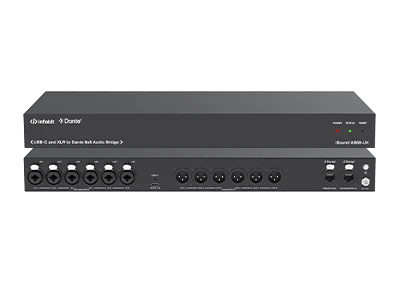
Selected models support AES67 RTP audio transport. Examples include the DP-T-22, DP-R-22, DP-BOX-202, DX-22 wallplates, DU-TR-22B, DB-22W, HD-ARC, and AB88-UX. AES67 support should be checked for every specified endpoint rather than assumed across all models.
Provide the product model, connection diagram, source and destination types, sampling rate, power method, Dante routing configuration, and a clear description of the issue. Screenshots from Dante Controller or the product’s web interface can also help identify configuration differences.
A well-defined Dante design starts with accurate channel, connector, processing, power, and control requirements. At インフォビット AV, we can help business buyers and system integrators match these requirements with suitable Dante interfaces, wallplates, DSPs, bridges, and controllers. Visit the INFOBIT AV Dante Audio product page to review available models, or contact INFOBIT AV for an online quotation, technical consultation, or project-file review.
直ちに連絡を取ることができるように,下記の要求の詳細を残してください.
