






iCam P20 ডেমো টার্গেট ট্র্যাকিং
iCam P20/P20N এআই-ভিত্তিক স্বয়ংক্রিয় ট্র্যাকিং ডেমো


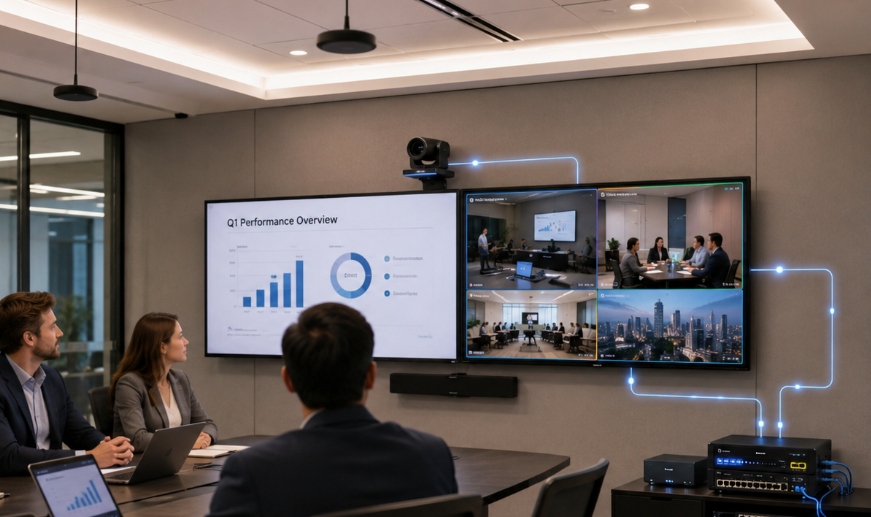
Modern meeting rooms are evolving from single-source presentation environments into multi-source collaboration spaces where HDMI signals, USB cameras, and network video inputs must work together in a single system. This shift is not driven by a single technology trend, but by practical requirements from enterprises that need more flexible, scalable, and unified AV infrastructure. At ইনফোবিট এভি, we develop integrated switching platforms designed to simplify this transition by combining multiple signal formats into one professional system architecture.
Modern meeting room design is no longer based on a single video signal type. Enterprises now deploy multiple video sources, including fixed HDMI presentation systems, USB-connected cameras, and network-based video inputs. Managing these sources separately increases system complexity, hardware dependency, and integration effort.
A hybrid architecture solves this by consolidating HDMI, USB, and network video processing into a single switching platform. Instead of using separate devices for switching, encoding, and routing, all inputs are processed within one unified system. This reduces hardware fragmentation and creates a more consistent signal workflow across the entire meeting environment.
দ্য আইট্রান্স ইউসি-HUB402 is designed around this requirement, allowing different video sources to be managed in a unified structure without requiring additional external processing devices.
The transition toward hybrid switching is not only a technology upgrade but also a response to real operational limitations in traditional AV environments.
Many existing systems rely heavily on fixed HDMI routing structures, which are not optimized for dynamic multi-camera conferencing scenarios. These systems typically require additional capture devices when integrating USB cameras or software-based conferencing workflows. As a result, system architecture becomes increasingly complex as requirements grow.
Another limitation is scalability. When additional video sources are introduced, traditional systems often require expanded hardware matrices or additional converters. This increases installation time, maintenance effort, and long-term system cost.
Hybrid systems eliminate these challenges by enabling multiple signal types to be processed within a single platform.
A hybrid architecture improves meeting room efficiency by unifying different signal types into a single processing layer. Instead of treating HDMI, USB, and network video as separate systems, the আইট্রান্স ইউসি-HUB402 processes them within one integrated platform.
The system supports:
This structure allows integrators to design systems where all video sources operate under one switching logic, reducing configuration complexity and improving operational consistency.
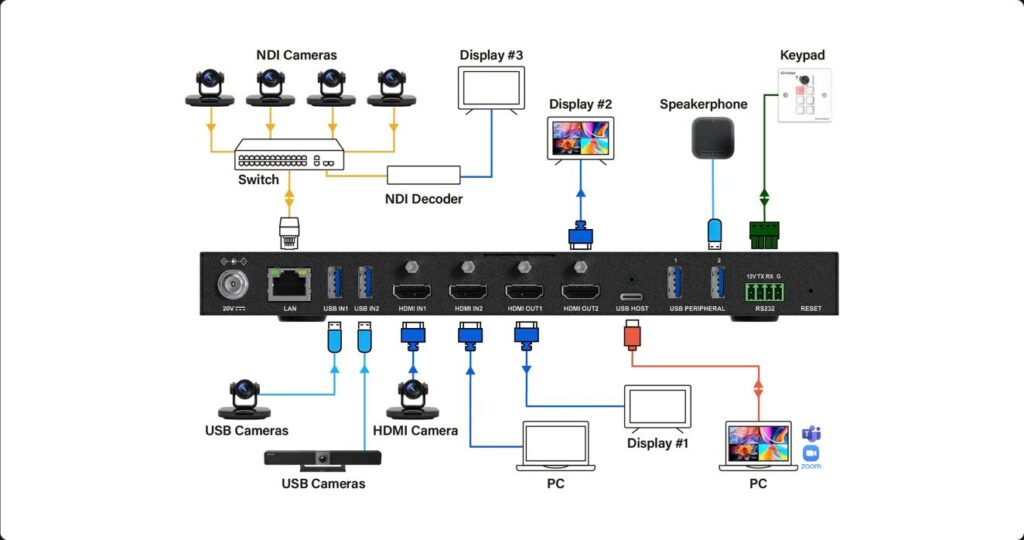
দ্য আইট্রান্স ইউসি-HUB402 is not only a switching device but also an upgrade path for existing AV environments. It allows integrators to enhance meeting room capabilities without replacing the entire infrastructure.
The device supports simultaneous multi-output workflows, including HDMI OUT1 for dedicated display output, HDMI OUT2 for multi-view configurations, USB HOST for direct computer connection, and NDI output for network video distribution.
This makes it suitable for upgrading traditional meeting rooms into hybrid environments without redesigning the entire AV system.
From a deployment perspective, hybrid switching architecture provides several operational advantages.
First, it reduces the number of standalone devices required in a system. By combining switching, processing, and output functions into one platform, integrators can simplify installation and reduce rack space requirements.
Second, it improves system consistency. All video sources are processed within a unified architecture, reducing compatibility issues between different hardware components.
Third, it enhances flexibility. With support for multiple output formats and control interfaces including Web UI, Telnet API, and RS232, UC-HUB402 can be integrated into both modern and legacy AV environments.
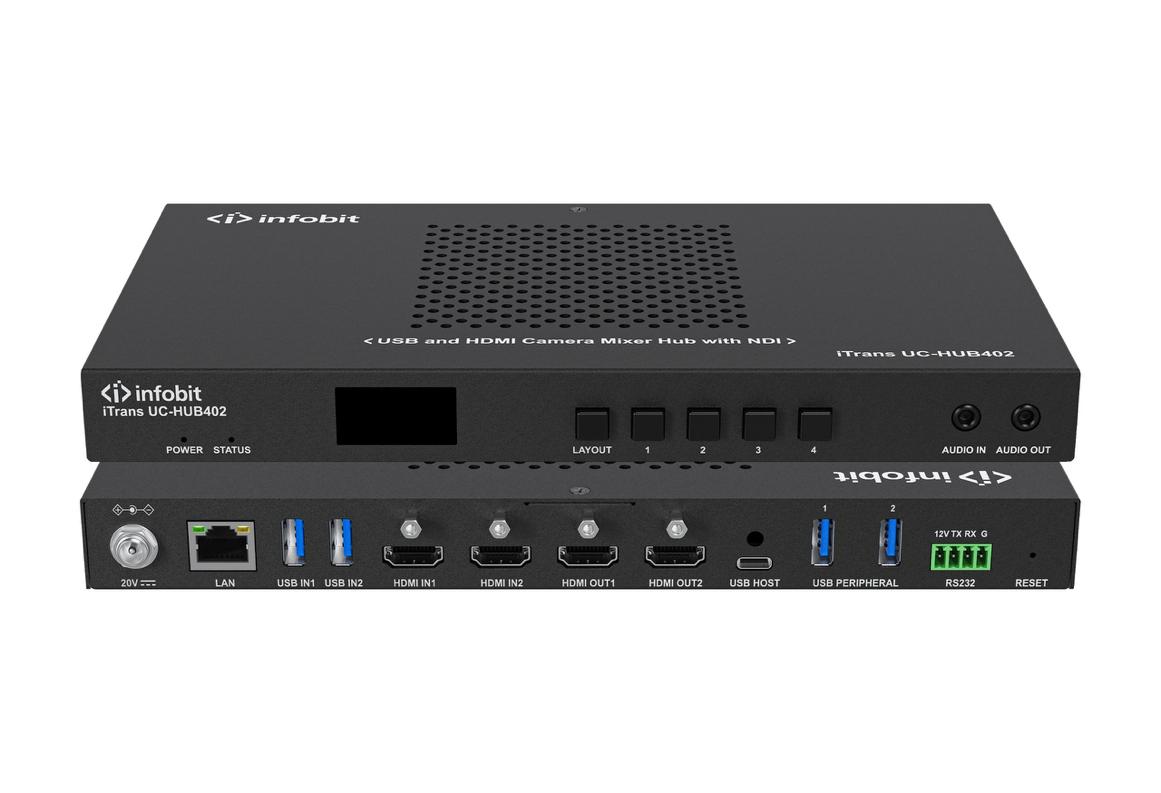
Modern meeting rooms require more than simple source switching. They require multi-view presentation capabilities that allow multiple video sources to be displayed simultaneously.
দ্য আইট্রান্স ইউসি-HUB402 supports multiple layout modes, including quad view, picture-in-picture, side-by-side, and other configurable display structures. These modes enable flexible visual presentation depending on meeting requirements.
This capability is particularly important in environments where multiple speakers or multiple camera angles need to be displayed in real time.
Hybrid USB and HDMI camera switching architecture is becoming a practical standard in modern meeting room design because it addresses real limitations in traditional AV systems. Instead of relying on multiple isolated devices, enterprises are moving toward unified platforms that support HDMI, USB, and network video inputs within a single system.
দ্য আইট্রান্স ইউসি-HUB402 reflects this direction by integrating multiple signal types, multi-view processing, and flexible output options into one compact switching platform. This allows system integrators to build more efficient, scalable, and adaptable meeting room environments.
At INFOBIT AV, we continue to develop integrated AV solutions that support this transition toward unified hybrid architectures, helping enterprises simplify deployment while improving collaboration efficiency.
A hybrid USB and HDMI camera switching system is an AV solution that combines multiple video input types, including HDMI sources and USB cameras, into a single switching platform for meeting rooms. The আইট্রান্স ইউসি-HUB402 supports both input types and processes them within one unified system.
A multi-camera switching system is commonly used in conferencing environments and lecture capture applications. The আইট্রান্স ইউসি-HUB402 supports multi-view layouts such as quad view and picture-in-picture, allowing multiple video sources to be displayed simultaneously in meeting rooms.
দ্য আইট্রান্স ইউসি-HUB402 supports two HDMI inputs, two USB camera inputs, and up to four NDI network video inputs, enabling multi-source video processing within one system.
Yes. It includes an integrated audio matrix that supports routing, mixing, volume control, and mute functions across HDMI, USB, and analog audio channels.
দয়া করে নীচে আপনার চাহিদার বিবরণ ছেড়ে দিন যাতে আমরা অবিলম্বে আপনার সাথে যোগাযোগ করতে পারি।
