







A Dante installation can work perfectly in a test setup and still become inconvenient after it enters a finished room. The key decision is often the connection format: should the analog interface sit inside a wall plate, or should it remain in a portable converter? The answer depends on signal direction, room layout, service access, and how often the system will change.
The installation decision begins with the signal path
A Dante wall plate and a portable converter perform related jobs, but they support different installation habits. A wall plate places the audio connection where users need it. A portable converter keeps the interface accessible for temporary systems, equipment racks, mobile production, or future relocation.
Before selecting the enclosure, we define four points:
- Where the analog source or destination is located
- Whether audio travels from XLR to Dante, Dante to XLR, or in both directions
- Whether the equipment will remain in one room
- Whether installers need fast access for testing or replacement
Dante transports digital audio over standard Ethernet networks, while network switches can use QoS functions to prioritize clock synchronization and audio traffic. The physical installation therefore affects more than appearance. It determines how the analog equipment joins the network and how easily technicians can maintain the signal path.
When a Dante wall plate is the better choice
A Dante wall plate suits a room with fixed connection points. It can be installed near a lectern, conference table, stage position, presentation area, or equipment location where users repeatedly connect microphones and other analog sources.
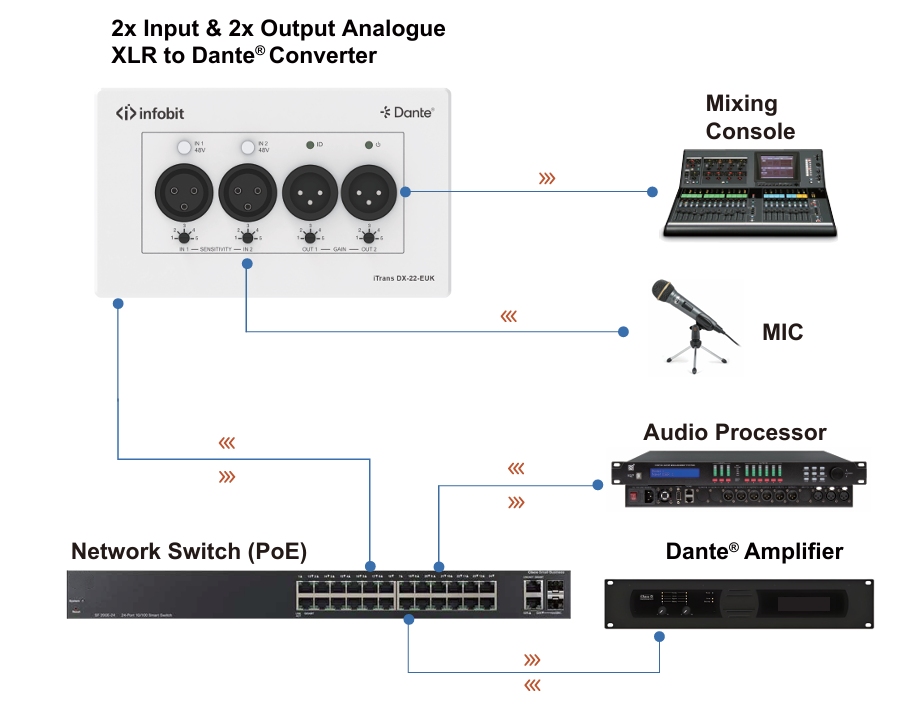
Our iTrans DX-22-US and iTrans DX-22-EUK are designed for this type of installation. Both provide two Dante inputs, two Dante outputs, and balanced or unbalanced XLR audio connections. The US version follows a standard 2-gang US faceplate format, while the EU and UK version follows the corresponding regional wall plate design. The product pages also specify input sensitivity and output gain control, 48V microphone phantom power, and magnetic covers for a cleaner installed finish.
This two-way structure is useful when a room needs more than a single transmit or receive path. For example, a local microphone may need to enter the Dante network, while a routed Dante signal may need to return to an analog amplifier or loudspeaker system. A 2×2 interface can handle both directions at the room boundary without placing separate converter boxes on a table.
The wall plate also provides useful configuration flexibility. The DX-22 series supports 44.1, 48, 88.2, and 96 kHz sampling rates at 24-bit, with configurable Dante device latency of 1, 2, or 5 ms through Dante Controller. The US model documentation also lists PoE and local power options.
A wall plate is usually the stronger choice when:
- The room has a permanent AV layout
- Users need a clear, accessible XLR connection point
- Cable visibility must be controlled
- The analog and Dante signal paths are both required
- The project uses regional wall box standards
- The installer wants to keep the converter close to the room endpoint
When a portable Dante converter works better
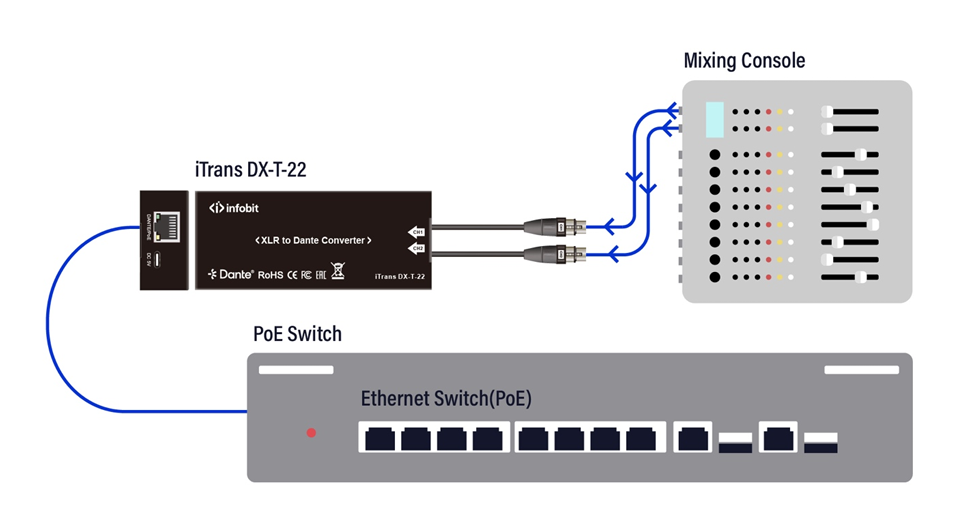
A portable converter is more suitable when the system must move, change, or remain easy to access. It can sit in a rack, on a tabletop, beside a mixer, near a stage box, or inside a temporary production system.
The iTrans DX-T-22 is a two-channel XLR-to-Dante analog transmitter. It accepts analog audio through XLR and sends the converted signal to the Dante network. The iTrans DX-R-22 performs the opposite function by receiving Dante audio and providing two analog outputs. Both are compact and designed to extend audio, Ethernet, control, and power through a network cable.
This direction-specific design makes the signal path easier to understand. A mixer output that must enter the Dante network needs a transmitter. A Dante signal that must feed an analog amplifier or powered speaker needs a receiver. Selecting the correct direction avoids unnecessary hardware and reduces commissioning errors.
Portable converters are especially useful for:
- Mobile event systems
- Rental and staging equipment
- Temporary meeting rooms
- Retrofit projects where opening the wall is impractical
- Equipment testing and commissioning
- Systems that may be moved between rooms
- Rack or tabletop installations with frequent service access
The portable format also simplifies replacement. If a converter requires testing, firmware work, or reconfiguration, a technician can remove it without disturbing a finished wall surface or the room’s fixed cabling.
Dante wall plate versus portable converter
|
Selection factor |
Dante wall plate |
Portable Dante converter |
|
Installation format |
Fixed in-wall connection point |
Tabletop, rack, stage, or temporary placement |
|
Typical signal structure |
Two Dante inputs and two Dante outputs with XLR I/O |
Dedicated transmitter or receiver direction |
|
User access |
Available at the room boundary |
Depends on equipment location |
|
Cable appearance |
Cleaner and easier to conceal |
More visible but easier to reroute |
|
Relocation |
Requires rewiring or wall work |
Can be moved quickly |
|
Best application |
Permanent meeting and presentation spaces |
Mobile, temporary, retrofit, and test systems |
|
INFOBIT examples |
iTrans DX-22-US, DX-22-EUK |
iTrans DX-T-22, DX-R-22 |
Technical checks before choosing the enclosure
Confirm the direction of the audio
The first check is not the model name. It is the direction of the audio.
An XLR-to-Dante transmitter is required when the source is analog. Typical sources include a microphone, mixer, playback device, or analog output from another AV processor. A Dante-to-XLR receiver is required when the destination is analog, such as an amplifier, loudspeaker, recorder, or analog mixer.
If the room needs both functions, a two-way wall plate can reduce the number of separate converter units. If the system only needs one direction, a portable transmitter or receiver may provide a simpler and more focused solution.
Match gain, phantom power, and connector requirements
Microphone signals and line-level signals do not have the same operating level. The installer should confirm whether the input requires sensitivity adjustment, phantom power, or a fixed line-level connection.
The DX-22 wall plate includes input sensitivity and output gain control, while its phantom power can be switched through a hard button. This makes it more adaptable to different microphone and XLR signal conditions.
Align sampling rate and latency
All Dante devices in the same signal path must be configured with compatible audio settings. A mismatch in sampling rate can prevent a route from operating correctly or create troubleshooting problems.
Latency should also match the network design. डेंटे नियंत्रक provides device status, latency information, clock stability data, and network monitoring functions. The appropriate value depends on network size, switch topology, and the sensitivity of the application. A short fixed-room path may use a lower setting, while a more complex network may require additional margin.
Confirm network and power planning
The wall plate location must have a suitable Dante network connection and enough space for the installed hardware. If PoE is selected, the network switch must provide compatible power. If local power is used, the installer should plan the DC supply before the wall is closed.
For portable converters, the network connection and power arrangement should be checked at the rack or tabletop position. A short visible cable run may be acceptable in a temporary system, while a permanent project usually benefits from a cleaner fixed endpoint.
Which format suits common projects?
A permanent conference room usually benefits from a Dante wall plate because users can connect equipment at a defined location without searching for a converter. A training room or lecture space may use the same approach when microphones or local playback devices are connected regularly.
A mobile presentation system is better served by a portable transmitter or receiver. The equipment can travel with the mixer or microphone kit and be reused at another venue.
A retrofit project requires more judgment. If the room already has a finished wall and no suitable box or conduit, a compact converter may reduce installation work. If the room is being renovated, a wall plate can provide a cleaner long-term result.
A two-way room system may combine both approaches. A wall plate can provide the local user interface, while portable converters can remain in the equipment rack where additional analog sources or destinations are located.
Need help selecting the right Dante interface?
Share the room layout, signal flow, connector requirements, and installation country with our team. We can help compare a fixed wall plate with a portable transmitter or receiver and recommend a practical configuration for your project. Visit the INFOBIT Dante Audio range इनपुट & आउटपुट वीडियो रिज़ॉल्यूशन contact INFOBIT for technical support and quotation.
Frequently Asked Questions
Is a Dante wall plate better than a portable converter?
Neither format is universally better. A wall plate is more suitable for a permanent room connection, while a portable converter is easier to move, test, replace, or use in a temporary system. The signal path and installation conditions should determine the choice.
What is the difference between XLR to Dante and Dante to XLR?
XLR to Dante converts analog audio into Dante network audio. Dante to XLR receives network audio and converts it into analog output. The transmitter and receiver should be selected according to the direction of the signal.
Can a Dante wall plate use PoE?
The iTrans DX-22 series supports PoE and local power options according to its product documentation. The network switch must provide compatible PoE, and the installer should confirm the power design before installation.
What sampling rates do INFOBIT Dante wall plates support?
The DX-22 series supports 44.1, 48, 88.2, and 96 kHz sampling rates at 24-bit. All connected Dante devices should be configured with compatible settings.
How should Dante latency be set?
Latency should reflect the network topology, number of devices, switch configuration, and application requirements. Dante Controller displays device latency and network information, allowing the integrator to select and monitor a suitable value.
