







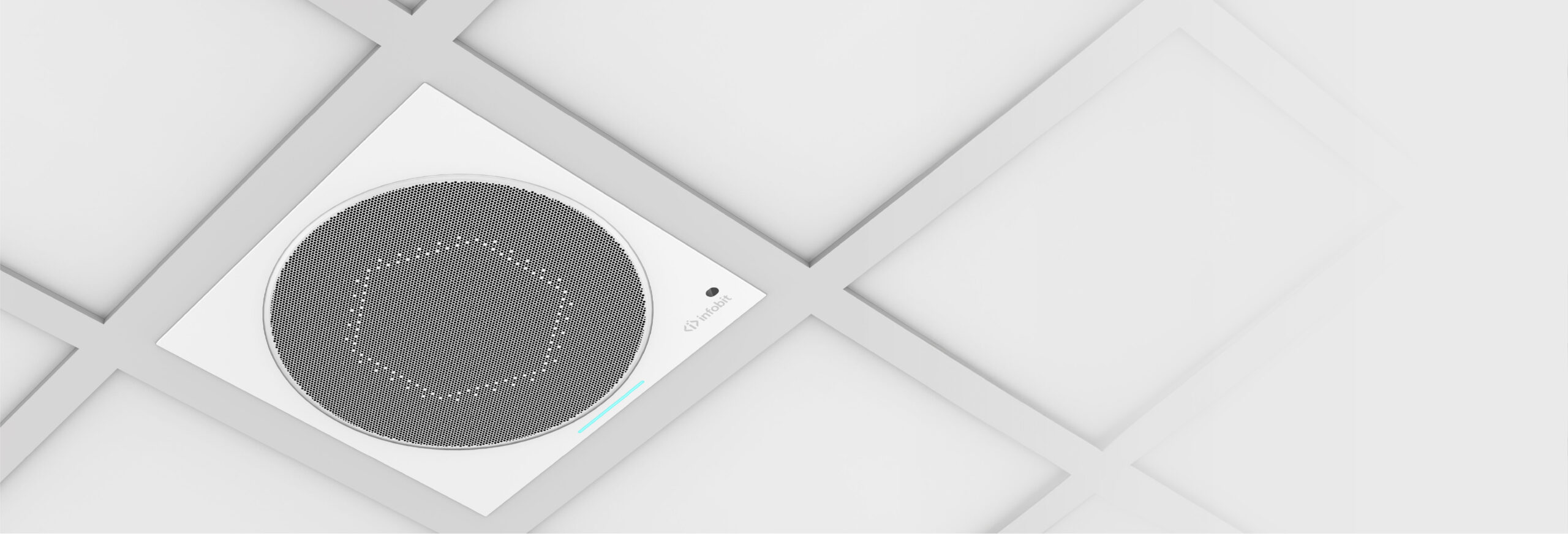
Sound reinforcement amplifies one presenter for a whole audience. Voice lift gently supports everyone who speaks, so the back of the room hears the front as if it were close by. This guide explains the difference, when a room needs help, how the signal chain works, and how Infobit builds it with the iSpeaker CM360, iSound DSPs and Dante speakers.
Two jobs, one goal
Both exist for one reason: speech that is easy to understand from every seat.
Sound reinforcement: one to many
A single talker, such as a lecturer, officiant or presenter, is picked up and played to a whole audience. The talker usually stands in a known place at the front, so a close microphone and speakers aimed at the audience do the job. Levels are often clearly above the natural voice, and the main engineering task is keeping the system out of feedback.
Voice lift: many to many
Anyone in the room may speak. Microphones and loudspeakers are split into zones, and a microphone feeds the speakers of the other zones, never its own. Listeners far from the talker get a small, even boost that blends with the live voice. Nobody should feel they are being addressed by a PA system.
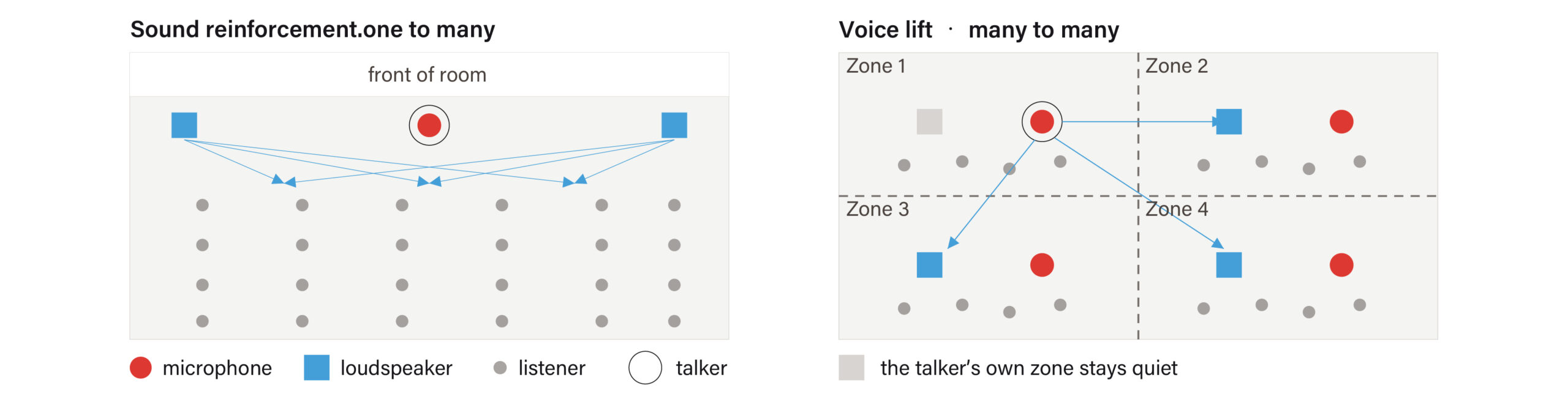
Figure 1. Concept only. Reinforcement sends one source everywhere; voice lift sends each zone’s talkers to the other zones.
At a glance
|
|
SOUND REINFORCEMENT |
VOICE LIFT |
|
Talker to listener |
One to many |
Many to many |
|
Typical talkers |
Presenter, lecturer, officiant |
Panel, class, board, council, hybrid meeting |
|
Microphones |
Worn, handheld or lectern, close to the mouth |
Ceiling or table microphones that cover the room, grouped by zone |
|
Loudspeakers |
Front-of-room, often one main cluster |
Distributed ceiling speakers in zones, each with its own level |
|
Character |
Clearly amplified |
Subtle; often noticed only when switched off |
|
Main design problem |
Feedback and coverage |
Feedback, zoning and delay across many open microphones |
|
Key processing |
EQ, feedback control, limiter |
Automixer, mix-minus matrix, delay, feedback control, and echo cancellation on the conference path |
KEEP IT GENTLE
Voice lift adds a few dB, about 3–6 dB at most, so it should sound natural. If the talker can hear the system working, it is probably set too high.
When a room needs help
People hear each other well in a small, quiet room. Distance, noise and echo each take that away, and they add up.
Signs a room needs help
|
FACTOR |
STARTING POINT |
WHY IT MATTERS |
|
Talker to far listener |
About 8 m (26 ft) or more |
Direct sound loses about 6 dB each time distance doubles: a listener at 8 m hears roughly 18 dB less than one at 1 m. |
|
Room size |
Roughly 10 × 10 m or larger |
Smaller rooms can still need help with soft talkers, noise or poor acoustics. |
|
Background noise |
About 45 dBA or lower, with HVAC running |
Lift raises speech and noise together. Noise sets the ceiling for what it can do. |
|
Reverberation |
Classrooms about 0.4–0.6 s; lecture halls about 1.0–1.5 s (RT60) |
A live room smears speech and leaves little gain before feedback. |
|
Ceiling height |
Counts as much as floor area |
It sets microphone pickup distance and how far speakers sit from listeners. |
These are typical starting points from industry practice, not rules. For classrooms, ANSI S12.60 sets a stricter noise limit of 35 dBA.
Special cases
Hybrid rooms
Several people speak from different seats and a remote group listens. Voice lift helps the local room; the remote group gets a separate pickup with echo cancellation. Keep the two paths apart.
Divisible rooms
Combined and divided states need different zones and mixes. Plan for the room states you have, with the ability to recall each one, and give every speaker the control it needs.
Listeners with hearing loss
Education guidance often cites speech about 15 dB above the noise for children and listeners with hearing loss. Voice lift helps, but a few dB cannot close a large gap, so lower the noise first. A hearing-assistance feed, such as an induction loop, is a separate provision.
Small rooms
Fix the cause first: HVAC or hallway noise, equipment fans, hard surfaces. Adding amplification to a noisy small room usually makes it worse.
Room acoustics checklist
- Noise: measure with HVAC and equipment running, and treat the loudest sources first.
- Reverberation: add absorption, especially where ceiling microphones will hear the room.
- Surfaces: look for glass, bare parallel walls and hard ceilings that cause flutter and echo.
- Ceiling: note height, tile type and any open plenum before choosing mounting.
- Placement: keep speakers away from microphones and aim them at listeners.
- Seats: mark the worst seats, near and far from any speaker, for later listening tests.
- Network: confirm Dante switching, cable runs and the PoE power budget.
- Hearing assistance: decide early where its feed will come from.
How it works: the signal chain
Pick up the voice, choose the talker, clean it, build a mix per zone, then time and shape it.
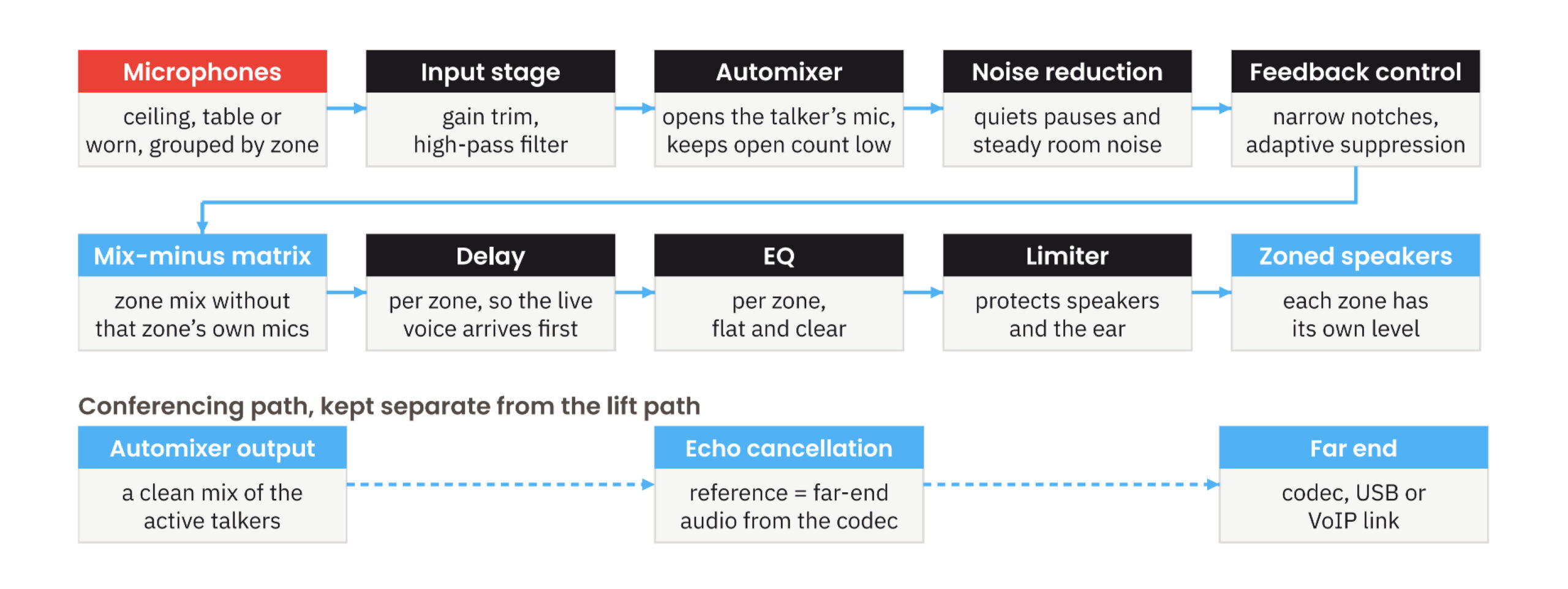
Figure 2. Typical order of the blocks. Exact order varies by platform. Dashed path: the conferencing feed, separate from the lift feed.
What each block does
|
BLOCK |
JOB IN A VOICE-LIFT SYSTEM |
|
Automixer and noise reduction |
Opens the microphone of whoever is speaking and holds back the others, so gain stays stable. Noise reduction stops background noise being amplified between words. |
|
Feedback control |
Narrow filters or adaptive suppression remove the few frequencies that ring first. It trims the last few dB; it does not replace good placement. |
|
Mix-minus matrix |
Builds each zone’s mix from every microphone except its own, with level offsets by distance. |
|
Retard |
Holds the speaker feed back so the natural voice arrives first and still seems to come from the talker. |
|
EQ and limiter |
EQ keeps each zone clear and flat; the limiter protects speakers and listeners from peaks. |
|
Annulation de l'écho |
Conference path only. It removes the far end from the local microphones so remote guests do not hear themselves. |
Dante and PoE
Dante carries digital audio over ordinary IP cabling, so microphones, DSP and speakers share one network, and PoE adds power on the same cable. Count latency across the whole chain; the lift path must stay fast.
TWO PATHS, NEVER ONE
Never route far-end audio into the lift feed. The lift feed is usually taken before echo cancellation to keep it fast; confirm with live calls. Adjust zone levels in the matrix rather than switching speakers with relays, so the echo canceller keeps its adaptation.
Design essentials
Mix-minus zoning
Split the room into zones, each with its own microphones and loudspeakers. A zone’s speakers receive every microphone except that zone’s own. The talker’s voice is then heard in the other zones, where it is needed, and not in the place where the microphone could pick it up again. Farther from the talker, more lift; close to the talker, little or none.
Number of open microphones
Each doubling of open microphones costs about 3 dB of gain before feedback. An automixer that keeps only the active talker open protects this margin.
Will it ring? PAG and NAG
Potential acoustic gain (PAG) is how much gain the room allows before feedback. Needed acoustic gain (NAG) is how much the farthest listener needs. If PAG exceeds NAG, the design has a chance; if not, expect ringing.
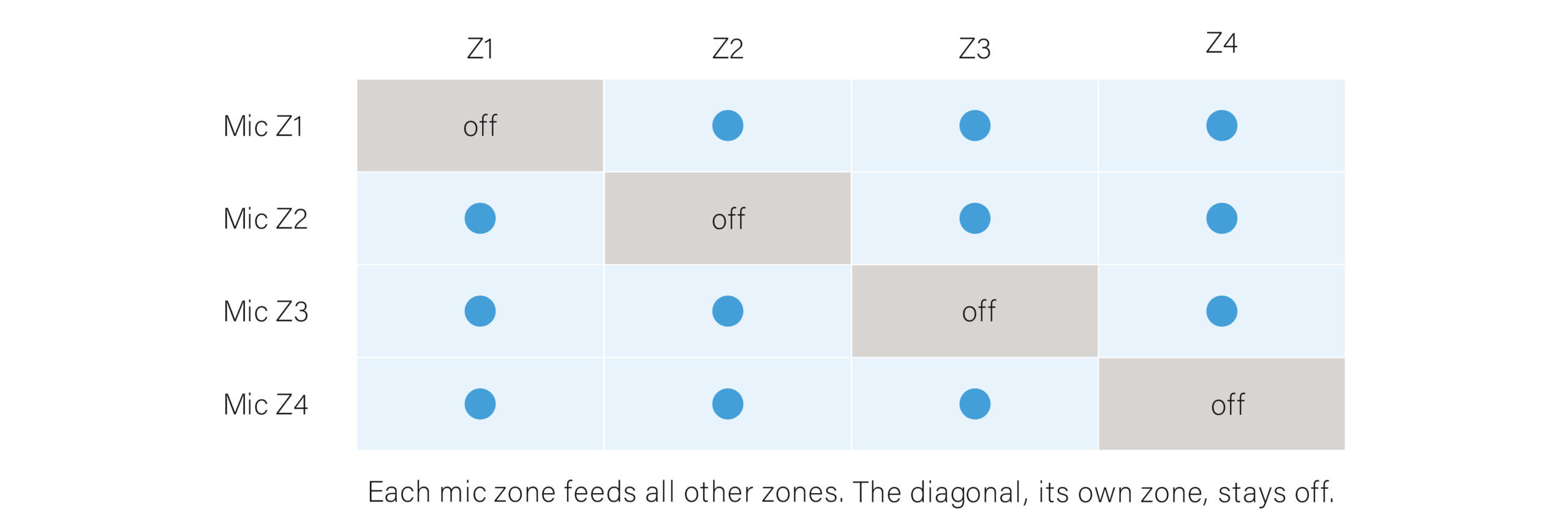
Figure 3. The mix-minus matrix for four zones.
PAG AND NAG, DISTANCES IN METRES
PAG = 20·log10( D0 × D1 / (D2 × Ds) ) − 10·log10(NOM) − 6 dB
NAG = 20·log10( D0 / Dn )
Pass when PAG − NAG ≥ 0 dB
D0 talker to farthest listener · D1 microphone to nearest loudspeaker · D2 listener to the loudspeaker serving them · Ds talker to microphone · Dn talker to nearest listener · NOM number of open microphones · the 6 dB is a stability margin.
Worked example. D0 = 8 m, D1 = 4 m, D2 = 2 m, Ds = 1 m, Dn = 2 m.
|
CASE |
PAG DB |
NAG DB |
MARGIN DB |
|
1 mic open |
18.1 |
12.0 |
+6.0 |
|
4 mics open |
12.1 |
12.0 |
+0.0 |
Opening four microphones instead of one uses the whole margin. The levers are in the formula: bring the talker closer to the microphone (halving Ds adds about 6 dB), keep NOM low, move speakers closer to listeners and away from microphones, and use directional microphones and speakers. The formula ignores reverberation, so treat a thin margin as fragile.
Delay and the precedence effect
Sound travels about 343 m/s, roughly 2.9 ms per metre. Listeners locate a sound by the first arrival, so if the live voice arrives before the loudspeaker copy, the voice still seems to come from the talker. Delay each zone’s feed to the time the natural voice needs to reach that zone, plus about 10 ms. The echo limits apply to the gap between the two arrivals at the listener, not to the delay setting: keep that gap well below the 35–40 ms where echoes become noticeable; beyond about 50 ms the speaker is heard as a separate source.
|
TALKER TO ZONE |
VOICE ARRIVES |
TOTAL FEED DELAY |
|
4 m |
12 ms |
about 22 ms |
|
8 m |
23 ms |
about 33 ms |
|
10 m |
29 ms |
about 39 ms |
Total delay, microphone to loudspeaker. Subtract the latency of the microphone, network and DSP to get the DSP setting; add none if the latency is already longer. Tune by ear.
The Infobit way
Infobit builds voice lift from three parts that work over one Dante network: a ceiling microphone with a speaker built in, a DSP when the room needs one, and Dante PoE speakers.
iSpeaker CM360
128-unit MEMS beamforming array and an integrated local-reinforcement speaker in one 597 × 597 mm ceiling tile.
Hybrid Mode: conference pickup and local reinforcement at the same time, or pickup only.
8 pickup zones and 8 reinforcement zones, plus one mute zone.
On-board AI noise reduction, reverberation suppression, feedback suppression and echo cancellation.
Dante PoE: one Cat6 cable for power, audio and control. Dante channel 1 is the local reinforcement mix; channel 2 is the remote conference pickup.
iSound 44D, 88D and 1616D DSP
Dante DSPs that supply the matrix, automixing, EQ, feedback control, delay and limiting when a room needs more than the CM360 does alone: more zones, more inputs, or finer control. Room states are stored as scenes and recalled when the room changes. The 1616D has the most outputs, for divisible rooms where every speaker needs independent control.
iSpeaker DAC6S
A Dante PoE ceiling speaker. It runs on PoE+ (802.3at), so an 802.3bt switch is not required. Budget 30 W per port and check the total against the switch’s overall PoE budget. The DCS60 Dante column speaker is the alternative where a column suits the room.
Two architectures
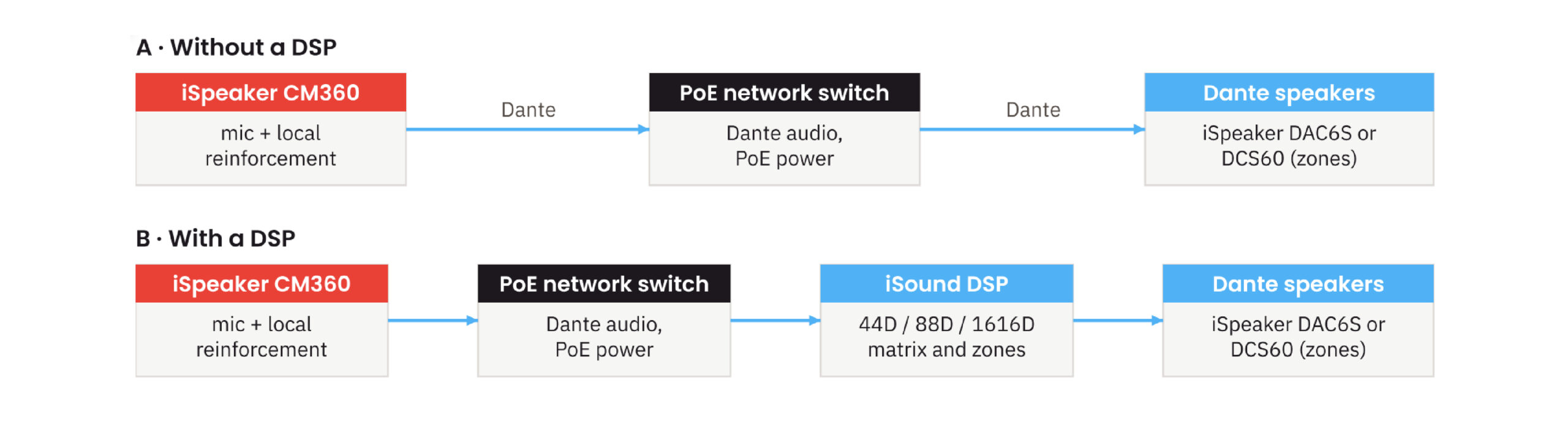
Dante channel 1 carries the local reinforcement mix; channel 2 carries the remote conference pickup. Speakers are fed over Dante; DAC6S speakers take PoE+ power from the same switch.
Figure 4. Concept only, not a wiring schematic.
Without a DSP. Simplest for one room and one lift mix: the CM360 does its own AI processing and the PoE switch links it to Dante ceiling or column speakers.
With a DSP. An iSound DSP sits between the CM360 and the speakers for zone-by-zone mixes, delay and EQ, and for rooms that combine or divide.
TYPICAL DSP STARTING POINTS
High-pass lift microphones at 100–120 Hz and speaker outputs at about 80 Hz; crosspoints from about −6 dB; a limiter on every output. After ring-out, fix the proven feedback notches, then save the scene.
Typical applications
|
ROOM |
WHAT VOICE LIFT DOES HERE |
INFOBIT APPROACH |
|
Boardroom |
Helps when seats are spread out or voices are soft. Often optional in a small, quiet room. |
CM360 in Hybrid Mode for pickup and gentle local reinforcement; pickup-only mode when no lift is needed. |
|
Divisible training room |
Keeps speech even whether the room is combined or split. |
iSound DSP with its own output for each zone (the 1616D has the most); a scene for each room state. |
|
Classroom |
The teacher moves and students at the back hear more easily. Suits listeners with hearing loss. |
Worn microphone for the teacher, CM360 over the seating, zoned ceiling speakers; camera-tracking data for a PTZ camera. |
|
Lecture hall |
One presenter plus questions from the floor: reinforcement for the presenter, lift for the audience. |
Presenter microphone, CM360 over the seating, delayed rear zones. |
|
Council chamber |
Many talkers, and every word must be heard in the public area. |
Per-seat microphones with an automixer, mix-minus zones, a separate hearing-assistance feed. |
|
Hybrid room |
Local people hear each other while remote guests hear a clean pickup. |
CM360 channel 1 for local lift, channel 2 for the far end; echo cancellation on the conference path. |
Commissioning checklist
Work in this order. Each step builds the margin the next one spends.
- Check the room. Confirm noise and reverberation are as surveyed; fix the worst sources.
- Set gain structure. Even levels from every input through to the loudspeakers.
- Speakers first. Check zone wiring and polarity, set each zone’s level and EQ for a clear, flat result.
- Start low. Begin matrix crosspoints at about −6 dB, with mix-minus and output limiters on.
- Set delay. Starting values from the delay table, less the system latency, then adjust by ear.
- Ring out with the usual number of microphones open. Raise gain until the first ring, note the frequency, cut it with a narrow notch, repeat, then back off about 6 dB.
- Conference path. Make live calls from every seat; confirm the far end is not heard in the lift path.
- Feedback suppression last, for the final few dB, never as a crutch.
- Natural, not loud. Walk the room and sit in the worst seats. Switch lift on and off; it should help without calling attention to itself.
- Hand over. Limit user controls, save the scene, record the settings.
HOW TO KNOW IT IS RIGHT
Speech at the back should sound like the talker, from the talker’s direction, at a comfortable level. Intelligibility can also be measured with STIPA; IEC 60268-16 rates 0.60–0.75 as Good.
